The Welcome Kit Confidence Gap: New Survey Reveals What HR Professionals Really Think About Employee Onboarding Swag
 Posted By Custom Ink Staff —
The Custom Ink Staff is a team of design enthusiasts and promo product experts dedicated to bringing your ideas to life. From screen printing secrets to the latest trends in custom gear, we draw on decades of collective experience to help you create something unforgettable.
SHARE:


Your new hire’s first day starts before they walk in the door.
Most HR teams assume the biggest barrier to a great Welcome Kit is budget. Our 2026 Employee Onboarding Experience Audit — which surveyed 300+ HR professionals responsible for employee Welcome Kits — says otherwise. The #1 challenge isn’t cost. It’s knowing what to put in the box.
And that curation problem is driving something larger: a widespread confidence crisis in onboarding swag. Most HR professionals are shipping Welcome Kits without any real certainty that they’re working.
In This Article
- Three-Quarters of HR Professionals Aren’t Sure Their Kit Is Working
- The #1 Challenge Isn’t Budget. It’s Knowing What to Put In the Kit.
- Spend More, Feel More Certain
- Measure It and You’ll Believe In It
- The Remote Gap: A Late Kit Sends the Wrong Message on Day 1
- What HR Professionals Actually Want From a Vendor
- What Different Teams Need
- When the Kit Lands: What Organizers Feel
- How Custom Ink Can Help
Key Takeaways
- 74% of HR professionals lack full confidence that their Welcome Kit is making a real impression on new hires, according to our 2026 Employee Onboarding Experience Audit.
- Curation beats budget as the top challenge — 53% of organizers struggle most with knowing what to put in the kit, outranking budget approval (47%) by six points.
- Spend correlates directly with confidence — organizers spending $100+ per hire score 4.27 out of 5 on confidence, nearly a full point above low spenders (3.43), yet 56% of respondents are in that low-spend bracket.
- Measuring onboarding outcomes is the single biggest confidence driver — HR professionals who formally track impact are ten times more likely to feel extremely confident in their kit than those who want to measure but haven’t started.
Three-Quarters of HR Professionals Aren’t Sure Their Kit Is Working
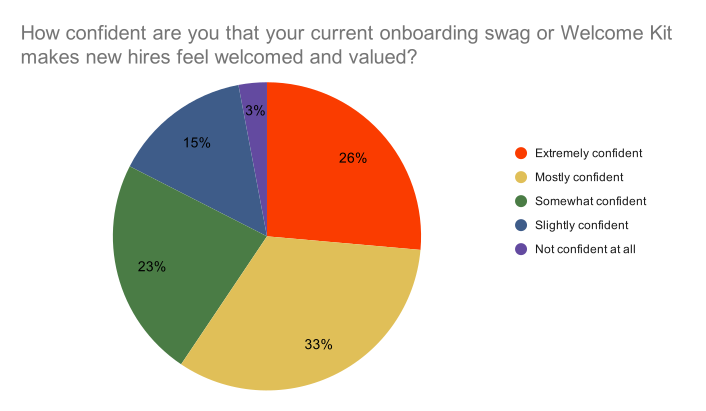
Only 26% of HR professionals say they’re “extremely confident” their onboarding kits make new hires feel welcomed and valued.
That means 74% — nearly three in four — are operating somewhere between “mostly confident” and “not confident at all.” They’re ordering the kits. They’re shipping the boxes. They just aren’t sure it’s landing.
When we broke down the full confidence picture across all 303 respondents in the 2026 Employee Onboarding Experience Audit, it looked like this:
- Extremely confident: 26%
- Mostly confident: 33%
- Somewhat confident: 23%
- Slightly confident: 15%
- Not confident at all: 3%
This is a solvable problem. And as we dug deeper into the data, the path forward became clear.
The #1 Challenge Isn’t Budget. It’s Knowing What to Put In the Kit.
Ask most people what holds HR teams back from better Welcome Kits and they’ll guess budget. They’d be wrong.
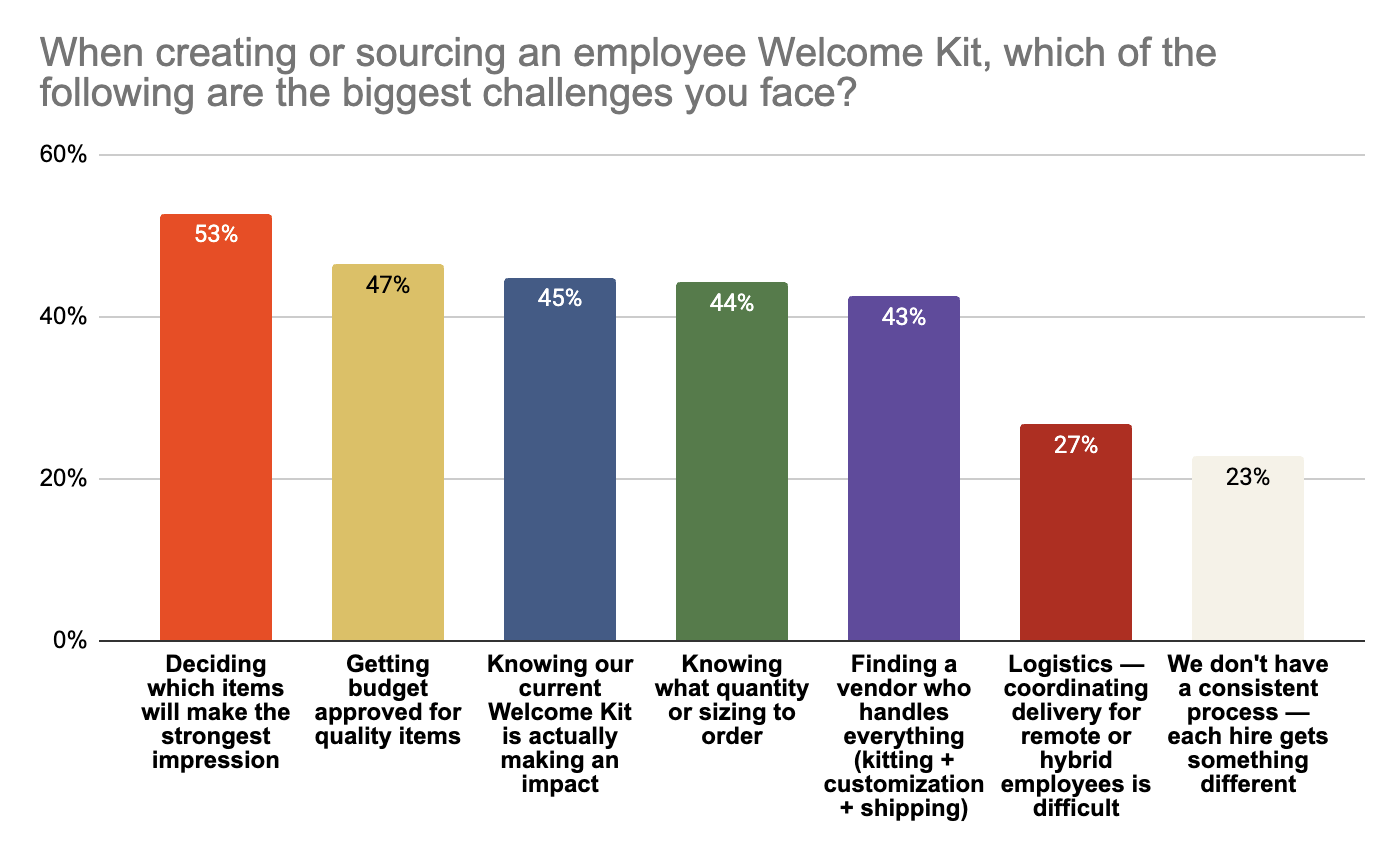
When we asked organizers to identify their biggest challenges, “deciding which items will make the strongest impression” came in first at 53% — beating budget approval (47%), impact measurement (45%), and vendor logistics (43%).
Curation is the #1 challenge. Not cost.
The Biggest Challenges in Building a Welcome Kit
- Deciding which items will make the strongest impression: 53%
- Getting budget approved for quality items: 47%
- Knowing if the current kit is actually making an impact: 45%
- Knowing what quantity or sizing to order: 44%
- Finding a vendor who handles everything (kitting + shipping): 43%
- Logistics — remote or hybrid delivery coordination: 27%
- No consistent process — each hire gets something different: 23%
The curation challenge is one our own team has even lived through firsthand.
“We’ve evolved a lot over the years. It used to be that new hires picked out a t-shirt in their size on Day 1 — based on whatever inventory we had in the office. Then we started adding overflow items, a tumbler here, a notebook there, but it wasn’t consistent. Now we have true branded boxes with a personalized note and a curated assortment. That overhaul genuinely changed how we welcomed people.”
Aubrey Cirillo, Director of Talent Acquisition, Custom Ink
There’s also a counterintuitive finding buried in the data: high spenders ($100+ per hire) actually report more challenges across every dimension — not fewer. They’re 24 points more likely than low spenders to struggle with vendor logistics (58% vs. 34%), and 12 points more likely to struggle with curation (62% vs. 50%). More investment doesn’t automatically mean less friction. It means the stakes are higher and the need for a capable partner is greater.
That’s exactly why our Inkers help organizers build kits that land — not just fulfill an order.
Spend More, Feel More Certain
The clearest signal in our data is the relationship between investment and confidence. It’s not subtle.
Organizers spending $100+ per hire average a confidence score of 4.27 out of 5. Those spending under $50 average 3.43 — nearly a full point lower. But here’s what makes that gap significant: 56% of all respondents are in that low-spend bracket. The majority of HR professionals are underinvesting and underconfident at the same time.
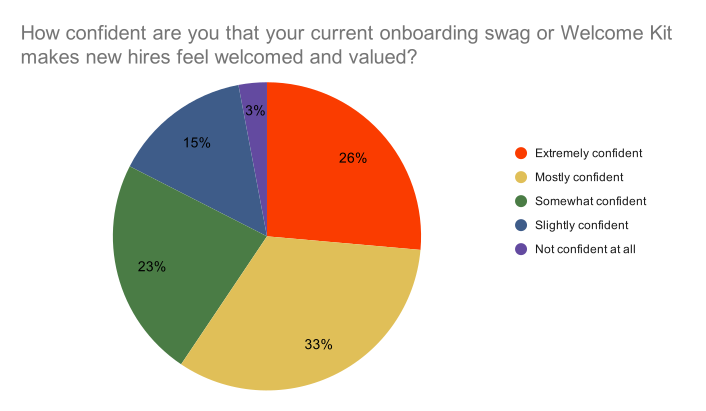
For an overall view on employer confidence by spend tier, see our chart below:
Measure It and You’ll Believe In It
Spend isn’t the only thing separating confident organizers from uncertain ones. Measurement may be the bigger lever.
82% of high spenders formally track onboarding impact — nearly twice the rate of low spenders (43%). But the connection between tracking and confidence holds up even independent of spend. Among organizers who formally measure onboarding outcomes, 41% are extremely confident in their kit. Among those who want to measure but haven’t started yet, that number drops to just 4%.
That’s a tenfold gap — driven not by the kit itself, but by whether the organizer knows if it’s working.
Knowing whether something is working turns out to be one of the most powerful things you can do to feel good about it. It’s also likely the most persuasive way to make the business case for a larger budget.
And for what it’s worth – data can be both quantitative and qualitative.
“Beyond data, some of the best signals are anecdotal — a new hire posting about their kit on social media, wearing their hoodie in their first team meeting, or sending a quick message to say thanks. Those moments tell you the kit landed the way you intended.”
Aubrey Cirillo, Director of Talent Acquisition, Custom Ink
The Remote Gap: A Late Kit Sends the Wrong Message on Day 1
82% of organizations in our survey have remote or hybrid employees. Among those, the Welcome Kit delivery picture is mixed at best.
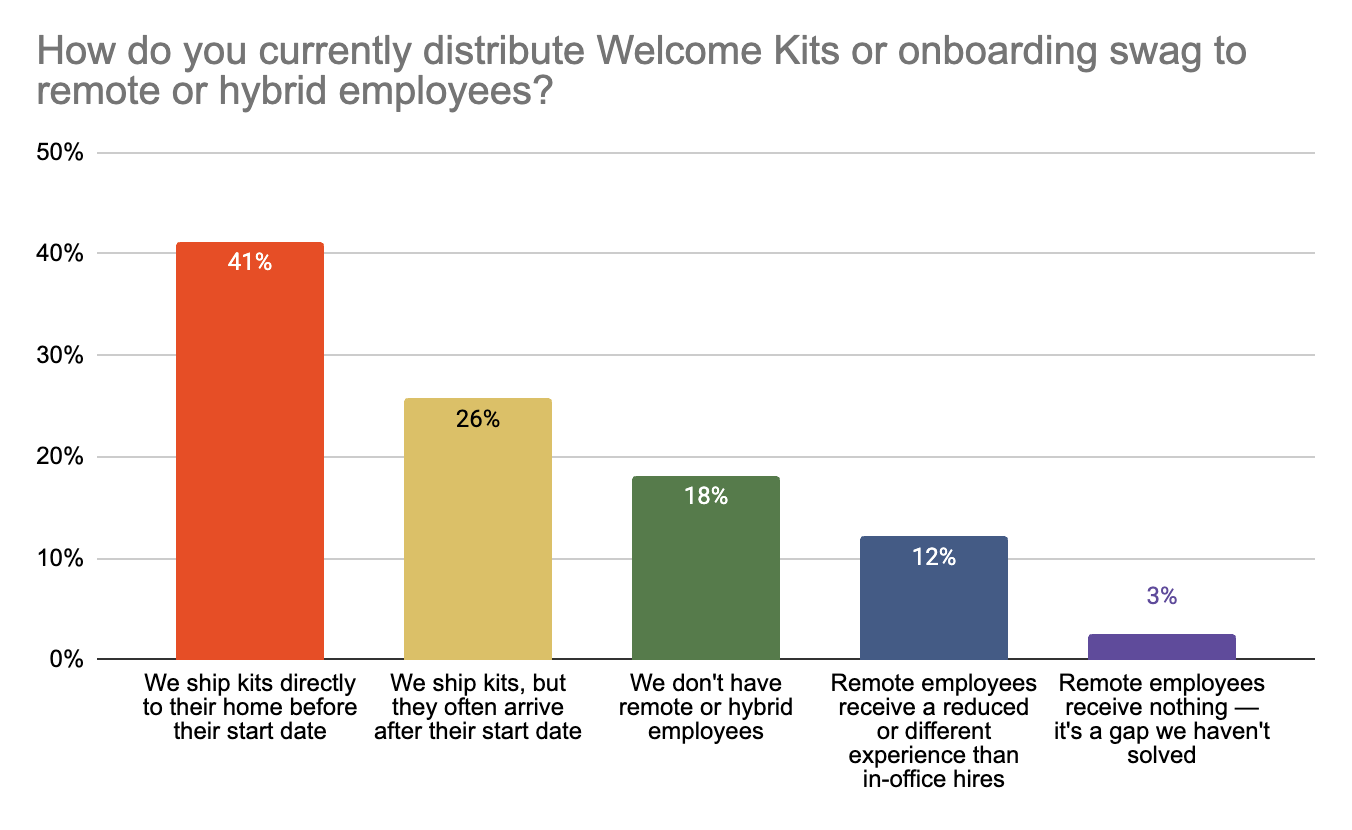
- 50% ship the kit to the employee’s home before their start date
- 32% ship kits, but they often arrive after the start date
- 15% of remote employees receive a reduced or different experience than in-office hires
- 3% of remote employees receive nothing — a known gap that hasn’t been solved
Roughly half of remote-enabled organizations are failing to deliver a full, on-time Welcome Kit to distributed new hires on Day 1. For a remote employee, the first day can already feel disconnected from the team and culture they’re joining. A kit that arrives late — or not at all — doesn’t just miss an opportunity. It reinforces exactly the wrong message at the most critical moment.
“The remote world made this real for us. Having something waiting for you when you open your laptop on Day 1 — something that connects you to something bigger — just feels good. It won’t replace walking the halls of a new office, but it closes some of that gap.”
Aubrey Cirillo, Director of Talent Acquisition, Custom Ink
Spend level matters here too. High spenders ship on time at a 57% rate. Low spenders manage 35%. Remote-first onboarding is a logistics problem, and it’s one that the right vendor partner can solve.
Our direct-to-employee shipping means every new hire — remote or in-office — gets the same experience on Day 1. See delivery options.
What HR Professionals Actually Want From a Vendor
We asked organizers to select their top three priorities when sourcing Welcome Kits. The results paint a clear picture of what the market is missing.
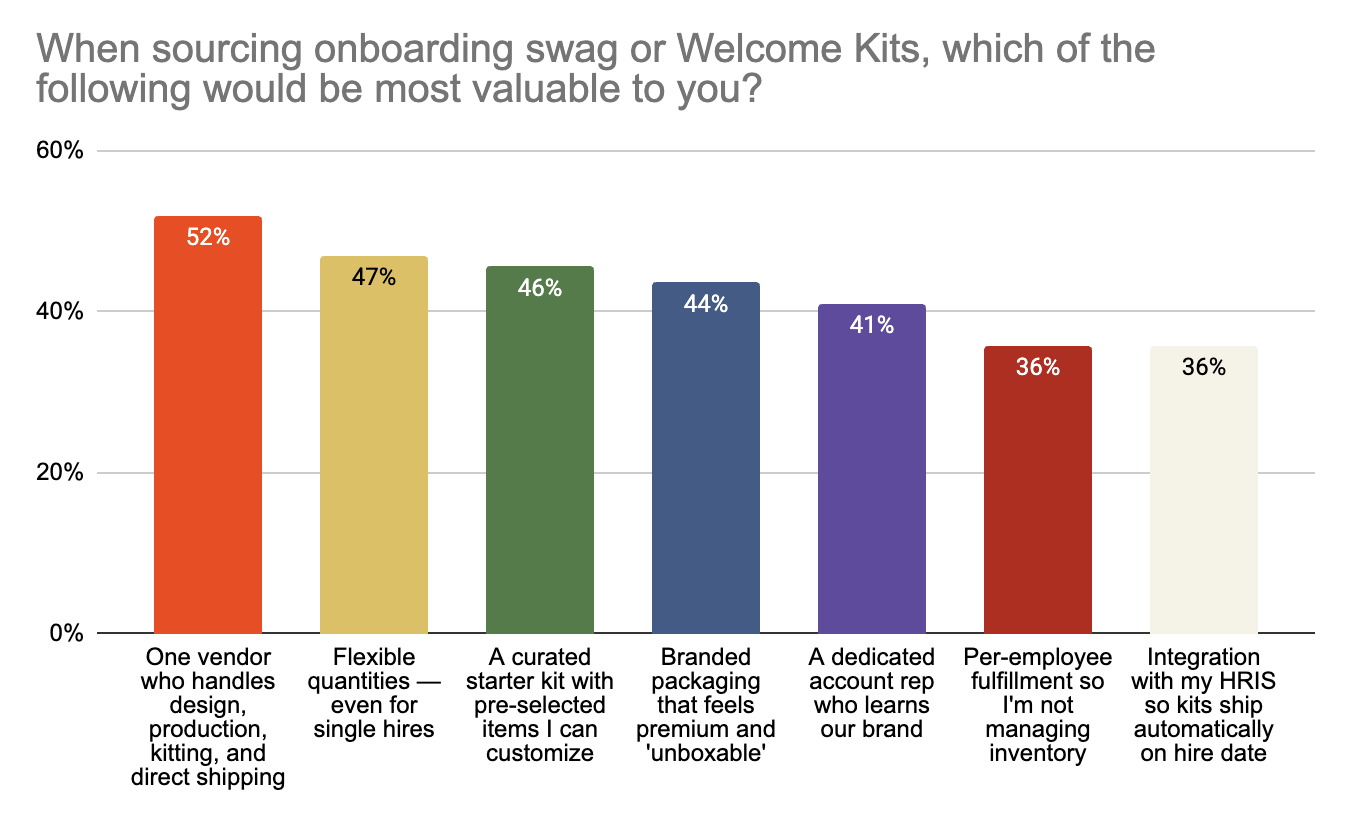
Top Vendor Priorities
- One vendor who handles design, production, kitting, and direct shipping: 52%
- Flexible quantities — even for single hires: 47%
- A curated starter kit with pre-selected items I can customize: 46%
- Branded packaging that feels premium and ‘unboxable’: 44%
- A dedicated account rep who learns our brand: 41%
- Per-employee fulfillment so I’m not managing inventory: 36%
- HRIS integration — auto-ship kits on hire date: 36%
The single full-service vendor leads by a clear margin. If the hardest part is knowing what to put in the kit, then a partner who can help curate, produce, and deliver it end-to-end doesn’t just save time. They solve the core problem.
The flexible quantities finding (47%) is also worth noting. Nearly half of HR organizers want the ability to order for a single new hire without minimum order constraints. Onboarding isn’t a bulk event — it’s an ongoing, one-at-a-time need.
We handle all of it: design, production, kitting, and individual fulfillment — including no minimums on many styles, no coordinating multiple vendors, no spreadsheets of sizes. Start designing your kit.
What Different Teams Need
When we sliced the data by buyer type and spend level, some sharp differences emerged.
Employee Programs Buyers: Premium Packaging Matters Most
HR professionals specifically responsible for employee programs — onboarding at scale, recognition programs, culture initiatives — are a distinct group with distinct priorities. 57% prioritize branded, premium “unboxable” packaging, compared to 41% of other buyer types. That’s a 16-point gap, the largest segment difference in the entire dataset.
They’re also more constrained: 55% cite budget approval as a top challenge (10 points above average), and they’re 12 points more likely to struggle with remote delivery logistics. They want the premium experience. They’re just fighting harder to get the resources to deliver it.
High Spenders: More Investment, More Complexity
You might expect that organizations spending $100+ per hire have figured it out. The data says otherwise. High spenders report higher challenge rates across every category — including curation (62%), vendor management (58%), and remote logistics (48%). They’re not struggling because they’re inexperienced. They’re struggling because they’re trying to do more, and complexity scales with ambition.
The upside: 82% of high spenders formally track onboarding impact. That measurement discipline is almost certainly part of why their confidence scores are higher. They know what’s working because they’ve built systems to find out.
Low Spenders: The Biggest Opportunity
The 56% of respondents spending under $50 per hire represent the largest — and most underserved — segment in the survey. Their confidence scores are lowest (3.43), their on-time delivery rates are lowest (35%), and only 43% formally track whether their kits are making an impact. In other words, they’re the least certain their kits are working, and the least likely to have the data to find out.
The dollar gap between where they are and where confident organizers operate isn’t as large as it might seem. Moving from under $50 to the $51–$100 tier — roughly the cost of one quality branded item — correlates with meaningfully better confidence and on-time delivery. And starting to measure, even informally, can close the confidence gap faster than any budget increase. For many low spenders, the barrier isn’t money. It’s awareness of what a better process looks like.
When the Kit Lands: What Organizers Feel
Despite all the uncertainty, when a Welcome Kit genuinely works, the person who made it happen knows it.
We asked: What outcome do you most hope your Welcome Kit influences? The answers were telling: 31% want new hires to feel welcomed and valued, followed by strengthening company culture (17%), improving retention (15%), and increasing new hire excitement (15%).

The kit is never really just about the kit.
It’s about culture, retention, belonging — things that matter long after the box gets unpacked. All of that is possible. But it only works when the logistics don’t get in the way.
How Custom Ink Can Help
If you’re one of the HR professionals navigating this — trying to build a Welcome Kit experience that actually lands, without a clear roadmap — we built our employee swag solutions for exactly this.
- Curation help when you need it: Our Inkers can help you build a kit that makes an impression, no guesswork required.
- One vendor for everything: Design, production, kitting, and direct-to-employee shipping — we handle the whole chain so you don’t have to coordinate five vendors.
- Flexible quantities: Order for one new hire or one thousand. No minimums that don’t fit how real onboarding works.
- Remote delivery you can count on: Our delivery options get kits there before Day 1 — not after.
You’re trying to make someone’s first day unforgettable. Let us help you pull it off.
Appendix: 2026 Employee Onboarding Experience Audit Data – Organizer Tables and Charts
Survey conducted March 2026 among 303 HR professionals responsible for employee Welcome Kits. The tables below contain the full underlying data referenced throughout this post.
| How confident are you your Welcome Kit makes new hires feel welcomed and valued? | % of Respondents |
|---|---|
| Extremely confident | 26% |
| Mostly confident | 33% |
| Somewhat confident | 23% |
| Slightly confident | 15% |
| Not confident at all | 3% |
| What are your biggest challenges when creating a Welcome Kit? (select all that apply) | % of Respondents |
|---|---|
| Deciding which items will make the strongest impression | 53% |
| Getting budget approved for quality items | 47% |
| Knowing if the current kit is actually making an impact | 45% |
| Knowing what quantity or sizing to order | 44% |
| Finding a vendor who handles everything (kitting + shipping) | 43% |
| Logistics — remote or hybrid delivery coordination | 27% |
| No consistent process — each hire gets something different | 23% |

| Approximate spend per new hire on Welcome Kit / swag | % of Respondents |
|---|---|
| Under $25 per person | 19% |
| $25–$50 per person | 37% |
| $51–$100 per person | 23% |
| $101–$200 per person | 15% |
| Over $200 per person | 5% |
| I don’t know — it’s not tracked | 2% |
| Confidence and measurement by spend tier | Low (<$50 / hire) | Mid ($51–$100 / hire) | High ($100+ / hire) |
|---|---|---|---|
| Avg. confidence score (out of 5) | 3.43 | 3.66 | 4.27 |
| Formally track onboarding impact | 43% | 43% | 82% |
| Ship kit before start date | 35% | 43% | 57% |
| Share of all respondents | 56% | 24% | 20% |
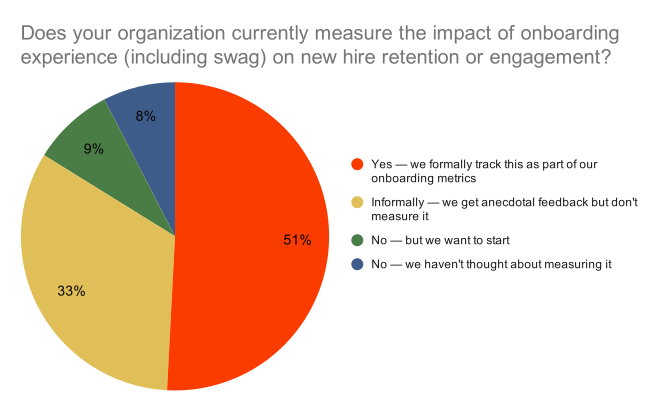
| Does your organization formally measure the impact of onboarding on retention / engagement? | % of Respondents |
|---|---|
| Yes — we formally track this as part of our onboarding metrics | 51% |
| Informally — we get anecdotal feedback but don’t measure it | 33% |
| No — but we want to start | 9% |
| No — we haven’t thought about measuring it | 7% |
| Confidence by measurement status | % Extremely Confident |
|---|---|
| Formally track onboarding impact | 41% |
| Informally — anecdotal feedback only | 13% |
| No — but want to start | 4% |
| No — haven’t thought about it | 13% |
| How does your organization handle Welcome Kits for remote / hybrid employees? | % of Respondents (among orgs with remote/hybrid employees) |
|---|---|
| We ship kits directly to their home before their start date | 50% |
| We ship kits, but they often arrive after their start date | 32% |
| Remote employees receive a reduced or different experience | 15% |
| Remote employees receive nothing — it’s a gap we haven’t solved | 3% |
| What would be most valuable when sourcing Welcome Kits? (select top 3) | % of Respondents |
|---|---|
| One vendor who handles design, production, kitting, and direct shipping | 52% |
| Flexible quantities — even for single hires | 47% |
| A curated starter kit with pre-selected items I can customize | 46% |
| Branded packaging that feels premium and ‘unboxable’ | 44% |
| A dedicated account rep who learns our brand | 41% |
| Per-employee fulfillment so I’m not managing inventory | 36% |
| HRIS integration — auto-ship kits on hire date | 36% |
| What single outcome do you most hope the Welcome Kit influences? | % of Respondents |
|---|---|
| Making new hires feel welcomed and valued | 31% |
| Strengthening company culture from Day 1 | 17% |
| Improving employee retention | 15% |
| Increasing new hire excitement | 15% |
| Accelerating time to productivity | 11% |
| Reinforcing employer brand perception | 10% |
| Challenges by segment | Employee Programs Buyers | All Others |
|---|---|---|
| Branded, premium “unboxable” packaging is a top vendor priority | 57% | 41% |
| Budget approval is a top challenge | 55% | 45% |
| Remote delivery logistics is a top challenge | 37% | 25% |

The Custom Ink Staff is a team of design enthusiasts and promo product experts dedicated to bringing your ideas to life. From screen printing secrets to the latest trends in custom gear, we draw on decades of collective experience to help you create something unforgettable.