We Asked 300+ Employees What They Actually Want in a Welcome Kit. Here’s What They Said.
 Posted By Custom Ink Staff —
The Custom Ink Staff is a team of design enthusiasts and promo product experts dedicated to bringing your ideas to life. From screen printing secrets to the latest trends in custom gear, we draw on decades of collective experience to help you create something unforgettable.
SHARE:


Everyone has an opinion about what should go in a new employee Welcome Kit. The HR team, the office manager, the CEO who saw something on LinkedIn.
We decided to ask the people who actually receive them.
Our 2026 Employee Onboarding Experience Audit surveyed 300+ employees — people who’ve started new jobs, gone through onboarding, opened (or didn’t open) a Welcome Kit — about what they want, what they remember, and what a kit actually does to how they feel on Day 1. The answers are more clear-cut than most employers probably expect.
In This Article
- The Wish List: What Employees Actually Want
- Timing Is Everything: The Day 1 Effect
- Quality Isn’t Optional. It’s the Message.
- The Retention Argument You Can Take to Finance
- When the Kit Lands: What Employees Remember
- The Bar Is Rising. Don’t Fall Behind It.
- Build the Kit They Actually Want
Key Takeaways
- A high-quality water bottle or tumbler is the #1 wish list item — 43% of employees named it in their ideal kit, the only item above 40% and 7 points ahead of the next choice.
- Timing drives belonging more than the kit itself — employees who received their kit on Day 1 were nearly twice as likely to say they completely belonged from the start (34% vs. 18% with no kit), and late delivery performed almost identically to no kit at all.
- 50% of employees say onboarding quality directly affected how long they stayed — 33% said a strong onboarding made them more committed, and 17% said a poor one made them leave sooner.
The Wish List: What Employees Actually Want
We asked employees to pick their top three items for a perfect Welcome Kit. No constraints, no budget limits — just what they’d actually want to find in that box on their first day.
The results cut through a lot of assumptions.
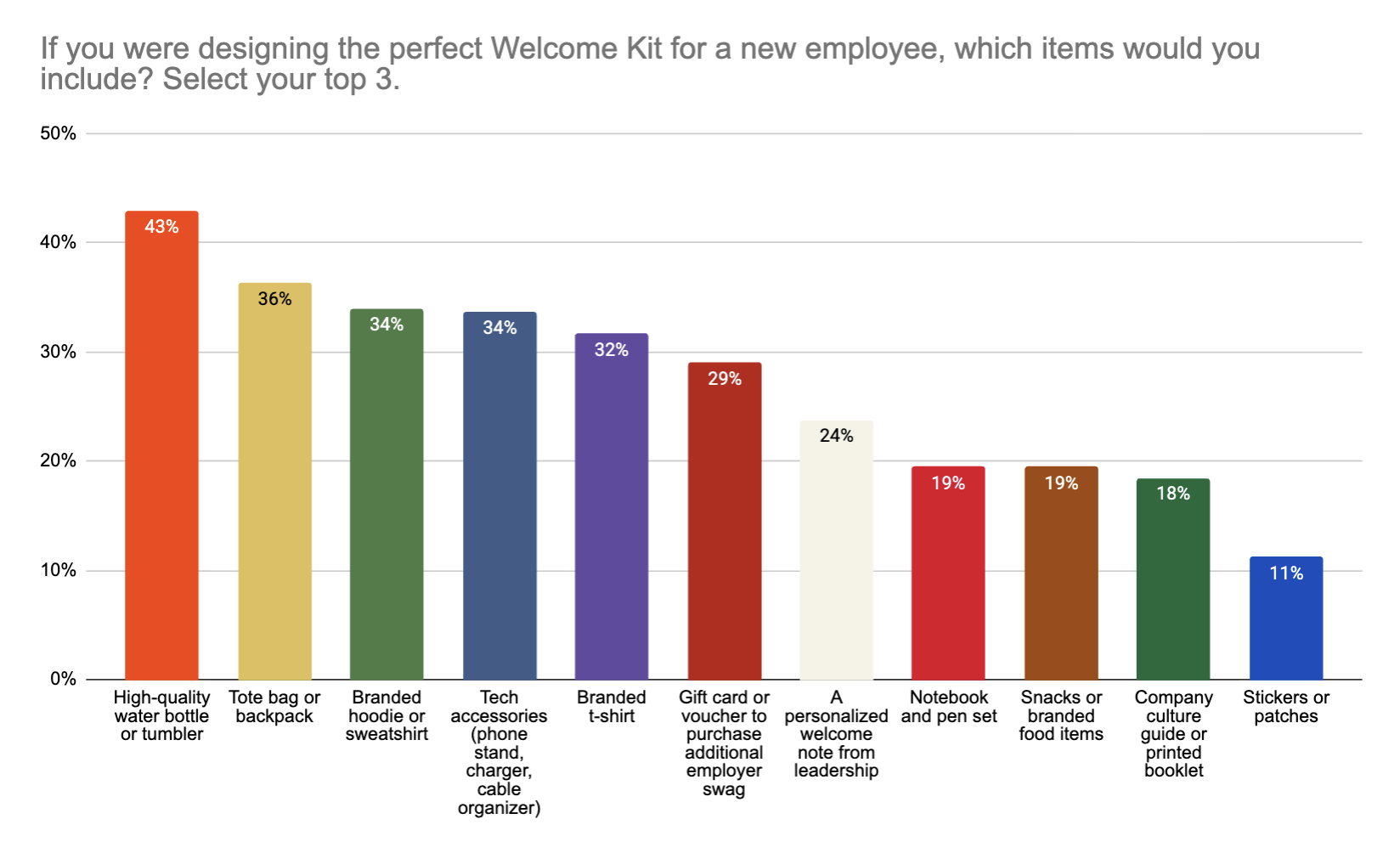
Top Items for the Ideal Welcome Kit (Select Top 3)
- High-quality water bottle or tumbler: 43%
- Tote bag or backpack: 36%
- Branded hoodie or sweatshirt: 34%
- Tech accessories (phone stand, charger, cable organizer): 34%
- Branded t-shirt: 32%
- Gift card or voucher to choose their own swag: 29%
- A personalized welcome note from leadership: 24%
- Notebook and pen set: 19%
- Snacks or branded food items: 19%
- Company culture guide or printed booklet: 18%
- Stickers or patches: 11%
A few things in here worth sitting with.
The Water Bottle Won. By a Lot.
At 43%, the high-quality water bottle or tumbler is the only item above 40% — and it’s not close. It makes complete sense: a quality tumbler is used every single day, sits on the desk, and signals investment. It’s a brand impression that compounds over time rather than fading after one wash cycle.
The key word in that item description is high-quality. A cheap plastic bottle wouldn’t place anywhere near the top. This isn’t about a branded vessel — it’s about something genuinely worth having.
The Hoodie Beats the T-Shirt.
This one surprised nobody who’s ever received a bad company t-shirt — but it’s worth having in data form. 34% of employees want a branded hoodie vs. 32% who want a t-shirt. The gap is small, but the signal is clear: employees want apparel that feels like something they’d actually choose to wear.
A quality hoodie costs more than a standard tee. That’s exactly the point. The extra spend communicates something that a $6 t-shirt quietly undermines.
The Welcome Note Punches Above Its Price Tag.
At 24%, the personalized welcome note from leadership is the only non-physical item in the top half of the list. It costs essentially nothing to include and ranks above snacks, notebooks, and culture guides. Something handwritten — or even personally signed — from a manager or executive carries weight that a branded item alone can’t.
Timing Is Everything: The Day 1 Effect
Knowing what to put in the kit matters. But when the kit arrives might matter even more.
We asked employees how strongly they felt like part of the team from the moment they arrived at their current job — and then cut that by whether they received a Welcome Kit on Day 1, received one late, or didn’t receive one at all.
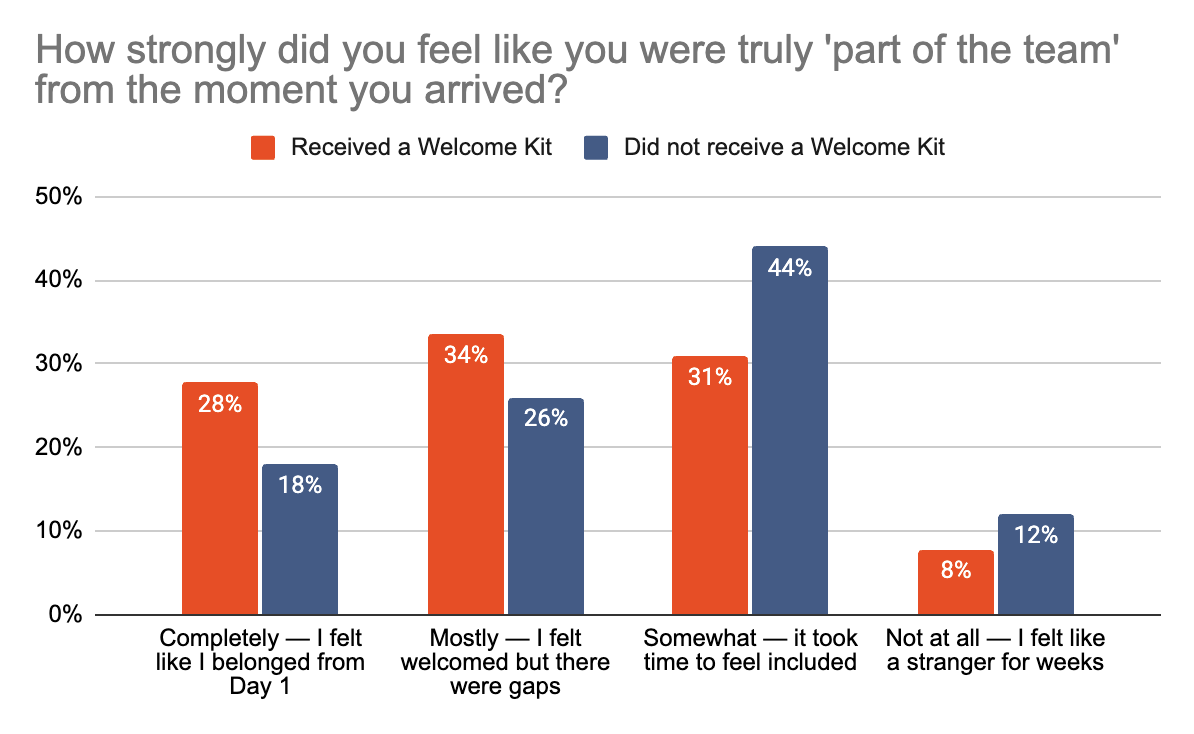
| Feeling on Day 1 | Kit on Day 1 (n=125) | Kit Arrived Late (n=66) | No Kit (n=50) |
|---|---|---|---|
| Completely belonged from Day 1 | 34% | 15% | 18% |
| Mostly welcomed, but gaps | 37% | 27% | 26% |
| Took time to feel included | 22% | 49% | 44% |
| Felt like a stranger for weeks | 7% | 9% | 12% |
The Day 1 kit group stands apart — 34% said they completely belonged from the moment they arrived. That’s nearly double the 18% rate among employees who received nothing.
The finding that deserves more attention: getting the kit late is almost as bad as not getting it at all. Late kit recipients look nearly identical to the no-kit group on every belonging measure. 49% of late recipients said it took time to feel included, compared to 44% with no kit. The numbers essentially tie.
The Welcome Kit isn’t a gesture that lands whenever. It’s a Day 1 signal — and if it misses Day 1, it mostly misses the point.
This is especially worth noting for remote and hybrid teams, where the kit is often the only tangible first-day experience a new hire gets. If it shows up on week three, they’ve already formed their first impression without it.
Our delivery options are built to get kits there before Day 1 — not after. For remote hires especially, we can ship directly to their home so the box is waiting when they log in for the first time.
Quality Isn’t Optional. It’s the Message.
We asked employees to respond to statements about branded gear quality. The results don’t leave much room for ambiguity.
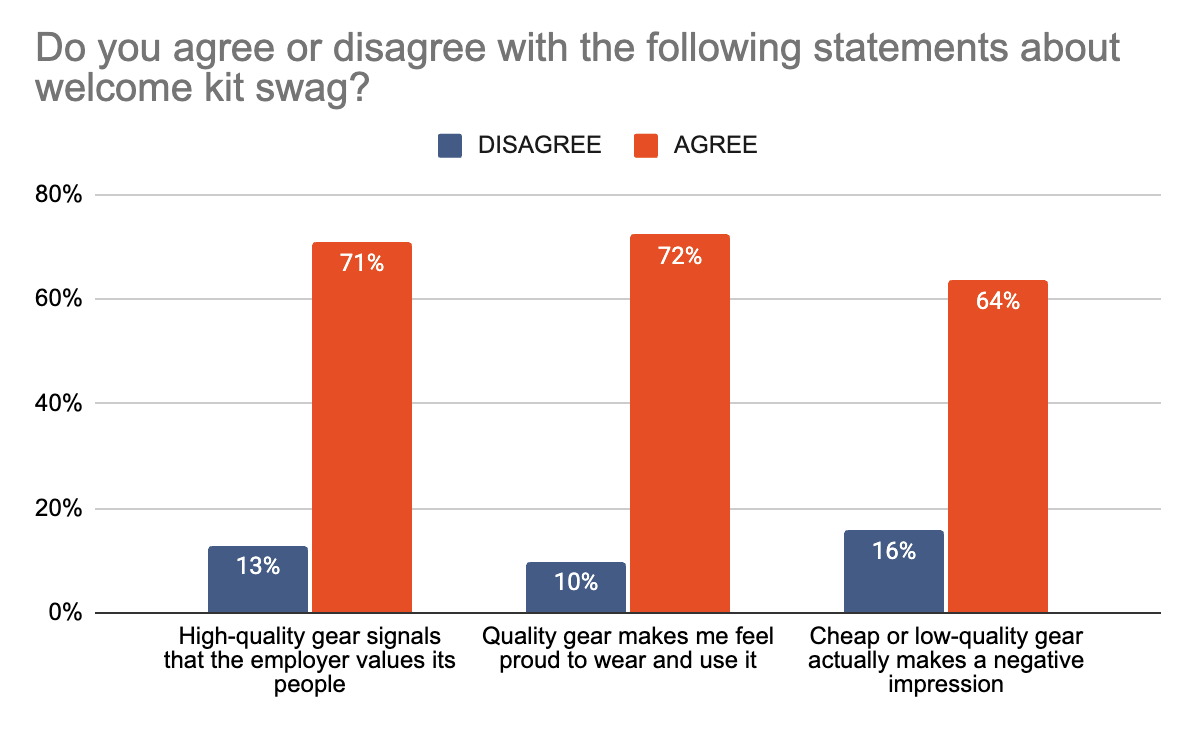
- 72% agree that quality gear makes them feel proud to wear and use it
- 71% agree that high-quality gear signals the employer values its people
- 64% agree that cheap or low-quality gear creates a negative impression of the employer
That last one is the one to sit with. Bad gear isn’t neutral — 64% of employees say receiving cheap, low-quality branded items creates a negative impression of the company. The kit you send isn’t just a missed opportunity if it’s low quality. It’s a liability.
This connects directly back to the wish list. The water bottle at #1, the hoodie over the t-shirt — employees aren’t asking for more stuff. They’re asking for better stuff. The volume of items matters far less than whether the items feel like something the company genuinely wanted to give them.
If you’re building a Welcome Kit and wondering whether to upgrade the quality of a single item or add another cheap one, the data says: upgrade.
Take a look at our employee swag options — everything from premium drinkware and custom hoodies to tote bags that are actually worth carrying.
The Retention Argument You Can Take to Finance
50% of employees say the quality of their overall onboarding experience directly affected how long they stayed at a job — 33% said a great onboarding made them more committed to staying, and 17% said a poor one made them leave, or want to leave, sooner. Another 19% called it a partial factor, putting total onboarding influence on tenure at 69%.
Not just how they felt. How long they stayed.
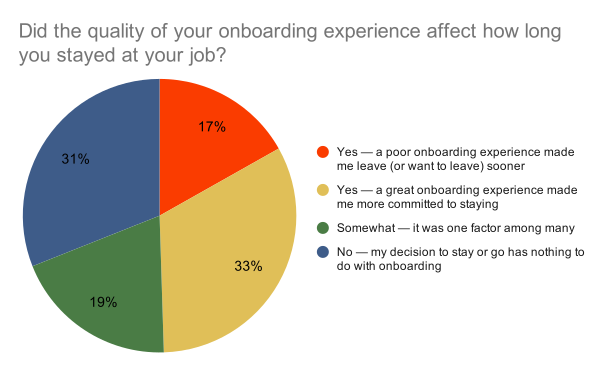
- 33% say a great onboarding made them more committed to staying
- 19% say it was one factor among many
- 17% say a poor onboarding made them leave, or want to leave, sooner
- 31% say their tenure decision had nothing to do with onboarding
Of course, there is much more to onboarding than new employee gear and swag. But the takeaway is that improving the overall onboarding experience has a direct linkage to employee retention, and the quality of your Welcome Kit can play a large role in that new employee experience.
The average cost to replace an employee runs between 1.5 and 2 times their annual salary. If a third of your workforce says a strong onboarding made them more committed to staying — and 17% say a weak one made them want to leave — the math on a $75 Welcome Kit starts looking very different.
This isn’t an argument for lavish onboarding budgets. It’s an argument for intentional ones. The kit that’s carefully chosen, well-made, and delivered before Day 1 is doing meaningful work that shows up much later in headcount spreadsheets.
When the Kit Lands: What Employees Remember
Among employees who’ve held more than one job and have received a Welcome Kit at some point, we asked a simple question: how did those onboardings compare to the ones where you didn’t get a kit?
80% said the kit onboarding was better. 34% said significantly better. Only 3% said it was worse.
And the memory effect is striking: 51% remember their kit onboardings more clearly than the ones where they received nothing. Only 18% remember the non-kit jobs more vividly. The other 30% remember them equally.
Kits don’t just feel better in the moment. They create a more durable first impression — the kind that employees are still drawing on when they decide whether to stay, whether to refer a friend, whether to call this place a good employer.
The Bar Is Rising. Don’t Fall Behind It.
One more data point worth knowing: among employees who’ve held multiple jobs, 63% say the quality of Welcome Kits has improved over time. 35% say significantly. Only 14% say kits have gotten worse.
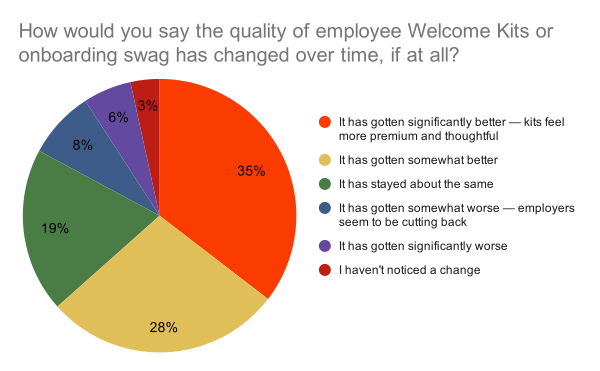
The employees joining your company today have a reference point. They’ve received kits before. They know what a thoughtful one feels like, and they know what a perfunctory one feels like. The benchmark isn’t what you sent five years ago — it’s what the last company they worked for sent last month.
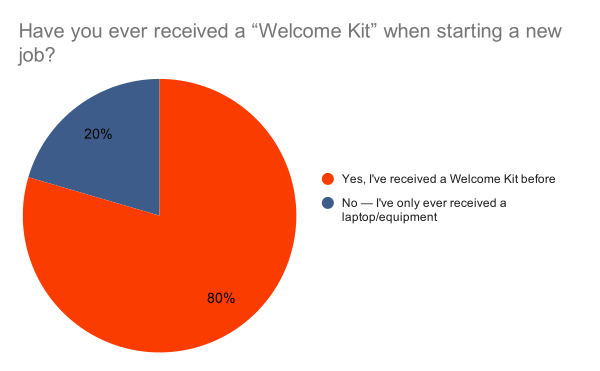
80% of the employees we surveyed have received a Welcome Kit at some point in their career. Your new hires are almost certainly in that group. They’re not coming in without expectations.
Build the Kit They Actually Want
The data points to a pretty clear brief: a high-quality tumbler, a tote or a hoodie, maybe some tech accessories — and a handwritten note from someone who means it. Not a lot of items. Good items. Delivered on or before Day 1.
If you’re building or rebuilding your Welcome Kit program, our employee swag covers everything on the wish list — drinkware, apparel, bags, and accessories — all customizable with your brand. And if you’re not sure where to start (like most HR professions our – see our survey here for that), our Inkers can help you build a kit that actually lands.
Your new hire’s first impression is already forming before they walk in the door. Make it a good one.
Appendix: 2026 Employee Onboarding Experience Audit — Employee Data Tables
Survey conducted March 2026 among 303 currently employed professionals who have started a new job within the last five years.
| If you were designing the perfect Welcome Kit, which items would you include? (Select top 3) | % of Respondents |
|---|---|
| High-quality water bottle or tumbler | 43% |
| Tote bag or backpack | 36% |
| Branded hoodie or sweatshirt | 34% |
| Tech accessories (phone stand, charger, cable organizer) | 34% |
| Branded t-shirt | 32% |
| Gift card or voucher to purchase additional employer swag | 29% |
| A personalized welcome note from leadership | 24% |
| Notebook and pen set | 19% |
| Snacks or branded food items | 19% |
| Company culture guide or printed booklet | 18% |
| Stickers or patches | 11% |
| How strongly did you feel like part of the team on your first day at your current job? | Kit on Day 1 (n=125) | Kit Arrived Late (n=66) | No Kit (n=50) | All Respondents (n=303) |
|---|---|---|---|---|
| Completely — I felt like I belonged from Day 1 | 34% | 15% | 18% | 23% |
| Mostly — I felt welcomed but there were gaps | 37% | 27% | 26% | 33% |
| Somewhat — it took time to feel included | 22% | 49% | 44% | 35% |
| Not at all — I felt like a stranger for weeks | 7% | 9% | 12% | 9% |
| How much does receiving a Welcome Kit influence how welcomed and valued you feel? (n=241 kit recipients) | % of Respondents |
|---|---|
| It makes me feel more welcomed and valued | 39% |
| It is a nice touch, but doesn’t meaningfully change how I feel | 25% |
| It significantly strengthens my sense of belonging | 18% |
| It makes no difference | 10% |
| It is one of the most meaningful parts of my onboarding | 8% |
| Positive sentiment combined | 65% |
| How did onboarding experiences with a Welcome Kit compare to those without one? (n=175 multi-job holders) | % of Respondents |
|---|---|
| Significantly better | 34% |
| Somewhat better | 46% |
| No difference | 15% |
| Somewhat worse | 3% |
| I’ve never had a job where I didn’t receive a Welcome Kit | 1% |
| Better combined | 80% |
| Which onboarding experiences do you remember more clearly? (n=175) | % of Respondents |
|---|---|
| Ones where I received a Welcome Kit | 51% |
| I remember them equally | 30% |
| Ones where I did not receive a Welcome Kit | 18% |
| Not sure | 1% |
| Does onboarding quality affect how long you stay at a job? | % of Respondents |
|---|---|
| Yes — a great onboarding made me more committed to staying | 33% |
| No — my decision to stay has nothing to do with onboarding | 31% |
| Somewhat — it was one factor among many | 19% |
| Yes — a poor onboarding made me leave (or want to leave) sooner | 17% |
| Onboarding impacted tenure (any) | 69% |
| Gear quality attitudes (% agree = somewhat + strongly agree) | % Agree | % Strongly Agree | % Disagree |
|---|---|---|---|
| Quality gear makes me feel proud to wear and use it | 72% | 35% | 10% |
| High-quality gear signals the employer values its people | 71% | 39% | 13% |
| Cheap or low-quality gear creates a negative impression | 64% | 26% | 16% |
| Quality of gear doesn’t affect how I feel about my employer | 44% | 16% | 28% |
| How has Welcome Kit quality changed over time? (n=175 multi-job holders) | % of Respondents |
|---|---|
| It has gotten significantly better — kits feel more premium and thoughtful | 35% |
| It has gotten somewhat better | 28% |
| It has stayed about the same | 19% |
| It has gotten somewhat worse — employers seem to be cutting back | 8% |
| It has gotten significantly worse | 6% |
| I haven’t noticed a change | 3% |
| Better combined | 63% |

The Custom Ink Staff is a team of design enthusiasts and promo product experts dedicated to bringing your ideas to life. From screen printing secrets to the latest trends in custom gear, we draw on decades of collective experience to help you create something unforgettable.