Screen Printing Custom T-Shirts
 Posted By Lissa Eckert —
Lissa has been helping customers create their perfect custom swag at Custom Ink since 2014 and loves to share her insights, tips, and tricks.
SHARE:


We’re printing perfectionists and that starts with deciding how to customize your t-shirt or other apparel. We choose the best printing method (screen printing or digital printing) based on the needs of your unique project (such as the product material, design, and numbers of colors).
With screen printing, we use a stencil (or “screen”) to apply layers of ink on the fabric, one color at a time. We can use screen printing for a variety of products (such as clothing, mugs, water bottles) and this method enables us to use custom colors.
Screen printing is great for spot colors and bold art. Because of the set up involved, screen printing is typically not available for no minimum products with single orders. (For those and for full-color, detailed art like photos, we use digital printing; both methods result in fabulous, high-quality results.)

Screen printing is sometimes called “silk screening” or “silk screen printing”, but generally those all refer to the same thing. (The mesh or “screen” used in the process historically was made of silk.)
How Screen Printing Works
Screen printing’s durability comes from how the ink is applied. Rather than sitting on top of the fabric or being pressed on via transfer, screen-printed ink is pushed directly through a mesh screen into the garment fibers under pressure — creating a bond that holds through repeated washing. Here’s the process from start to finish.
- Artwork is separated by color. Your design is digitally divided into individual color layers. Each color in the design becomes its own layer in the production file.
- A screen is created for each color. Using a light-sensitive emulsion and a UV exposure process, a mesh screen is burned with the stencil for one color layer. A design with three colors requires three separate screens.
- Ink is applied one color at a time. The garment is placed on a flat printing board, and each screen is aligned and printed in sequence. A squeegee pushes ink through the open mesh areas of the stencil onto the fabric surface below.
- Each layer is cured between passes. After each color is applied, the garment passes through a heat dryer to partially cure the ink before the next color is printed on top. This prevents colors from bleeding into each other.
- The final print is fully cured. After all colors are printed, the garment goes through a conveyor dryer at high temperature to permanently bond the ink to the fibers. The result is a print that flexes with the fabric, resists cracking, and lasts through hundreds of washes.
The setup involved — one screen per color — is what makes screen printing most cost-efficient at larger quantities. The time to burn and align screens is the same whether you’re printing 12 shirts or 200. Once the screens are set, the per-unit cost drops significantly with volume. That’s why screen printing and digital printing are complementary methods rather than competing ones: small batches and complex artwork typically go digital, while larger orders with bold designs go to screen.
Design Tips for Screen Printing
Screen printing handles bold, graphic designs better than any other print method — but getting the best result means designing with the process in mind. Here’s what our Inkers recommend.
- Keep colors to 1–6 for the best value. Each ink color requires its own screen setup. More colors means more screens, which increases the setup cost. The good news is that you can create striking designs with a limited palette — many of the most iconic t-shirt prints use only 2 or 3 colors.
- Use vector files when possible. AI, EPS, and SVG files are resolution-independent and scale to any print size without quality loss. They also make color separations more accurate. If your artwork was built in Illustrator, send the native AI file. If you’re uploading a raster image (PNG, JPEG), aim for at least 300 DPI at the intended print size.
- Bold, clean edges print best. Screen printing excels at solid fills, hard edges, and clean graphic shapes. Thin strokes, very fine text, and small details can be tricky — aim for a minimum stroke weight of 1pt at print size and a minimum text size of 6pt for legibility.
- Skip photographic gradients. True photographic images and smooth color gradients require digital printing (DTG or DTF). Screen printing can simulate gradients using halftone dot patterns, but for photo-realistic or full-color artwork, digital printing is the right method.
- Pantone matching is available. If your design uses brand-specific colors, our team can match Pantone values for exact color accuracy — something digital printing cannot replicate. Mention your Pantone codes when submitting your order.
- Not sure if your design is screen-print-ready? Our design experts review every order before it goes to production. If your design would print better with a different method or a small adjustment, they’ll flag it before anything is printed.
Screen Printing vs. Digital Printing: When to Choose Which
Screen printing and digital printing each have a clear home court. We choose the method based on your design, quantity, and fabric — and in many cases the decision is straightforward. Here’s the breakdown.
| Screen Printing | Digital Printing (DTG/DTF) | |
|---|---|---|
| Best order size | 24+ pieces — setup cost amortizes well at volume | Any quantity, including single items — no setup cost |
| Design complexity | Best with 1–6 bold colors; clean graphic shapes | No color limit — photographs, gradients, 20+ colors all print the same |
| Color cost | Setup charge per ink color; simpler = lower cost | Same price regardless of number of colors in the design |
| Print durability | Excellent — plastisol ink bonds deeply into fibers; resists cracking over hundreds of washes | Very good; may soften slightly in color over many washes |
| Print feel | Slight raised surface where ink is applied; more noticeable on large solid fills | DTG: soft, nearly invisible feel; DTF: slight texture from film transfer |
| Fabric types | Works on most fabrics; most reliable on cotton and 50/50 blends | DTG: cotton and cotton-heavy blends. DTF: virtually any fabric |
| Pantone matching | Yes — exact brand colors can be matched to Pantone values | No — colors are approximated via RGB/CMYK digital process |
| Photographic images | Not ideal — gradients require halftone simulation | Yes — DTG excels at photorealistic and full-color artwork |
| Best for | Large group orders (teams, events, companies) with bold logos or graphic designs | Small batches, full-color artwork, one-offs, personalized names/numbers |
When an order could go either way, we default to the method that gives you the best result at the best price. Our design experts are always available to advise before you commit — reach out via our design help center or give us a call.
What Our Customers Say About Screen-Printed Shirts
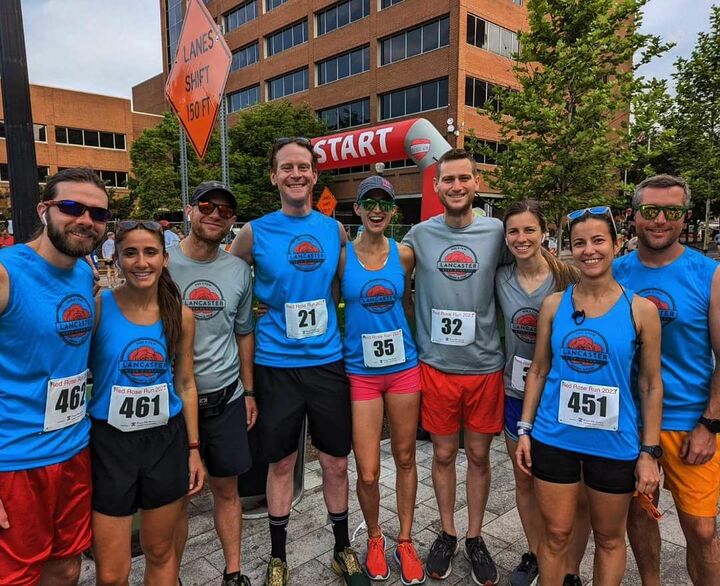
“After 5 years with my running group, we finally got shirts made for the Red Rose Run in Lancaster last year. They got a lot of attention and have been great as a walking advertisement for our group. It was so helpful to visit the Custom Ink shop in person to work on the design and pick out nice quality shirts.”
— Lancaster Beer Runners | View full story
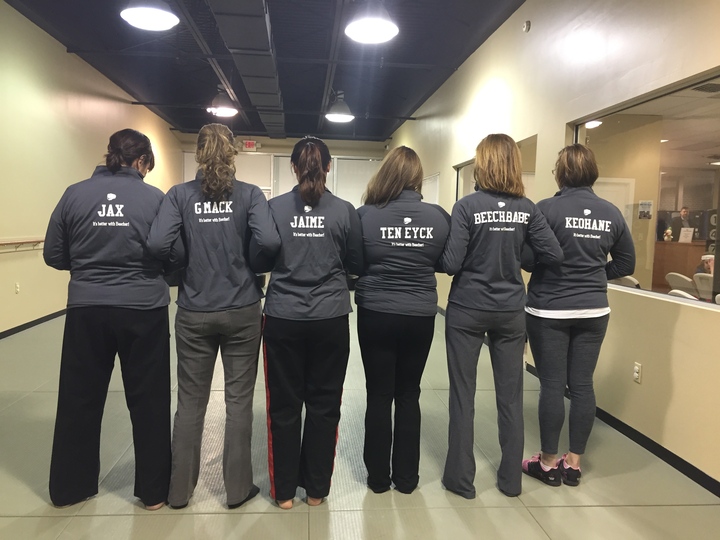
“Loved Custom Ink! The quality is amazing and the customer service was absolutely stellar. Thank you for everything!”
— Beecher Bootcamp | View full story
Frequently Asked Questions About Screen Printing
Q: What is screen printing and how does it work on custom t-shirts?
Screen printing is a technique where ink is pushed through a mesh screen onto fabric. Each color in your design requires a separate screen, and the ink is applied one color at a time. This method produces vibrant, long-lasting prints that hold up well to repeated washing. We use high-quality plastisol inks that bond permanently with the fabric fibers, ensuring your screen-printed custom t-shirts look great for years.
Q: How many colors can I use in a screen-printed t-shirt design?
Most screen-printed designs use between one and six ink colors. Each color requires a separate screen, so designs with fewer colors are typically more cost-effective for larger orders. Our Design Lab makes it easy to see exactly how your design will look and how the number of colors affects pricing. For designs with many colors or photographic images, digital printing may be a better option.
Q: How long does it take to get screen-printed custom t-shirts?
Orders typically arrive at your door within 2 weeks with our free standard shipping. If you need your shirts sooner, we offer rush options for an additional charge. Our delivery options page has all the details on turnaround times. We always recommend ordering at least a few weeks before your event to allow time for design review and any adjustments.
Q: What types of fabric work best for screen printing?
Screen printing works well on most fabric types, but 100% cotton produces the most vibrant results. Cotton absorbs ink beautifully, creating bold, long-lasting prints. Blended fabrics (like cotton/polyester blends) and tri-blends also print well, though colors may appear slightly different due to the fabric texture. For performance wear, we use specialized inks designed to bond with synthetic materials.
Q: Is there a minimum order quantity for screen-printed t-shirts?
Screen printing involves a setup step for each ink color — burning a physical screen and aligning it on the press — which means the method is most cost-efficient at larger quantities. For screen-printed custom t-shirts, we typically recommend 24 or more pieces to get the best price per unit. At that quantity, the setup cost spreads across enough shirts that the per-unit economics make sense.
If you need fewer than 24 pieces — or a single item — we’ll route your order to digital printing (DTG or DTF), which has no screen setup step and works for any quantity down to one. The result is the same high-quality print; the method just matches your order size. You can also filter our product catalog by no minimum to see styles available for small-batch orders.
For larger group orders where everyone pays separately, our group order feature lets each person choose their own size and submit payment individually — no spreadsheet required.
Q: How do I care for screen-printed custom t-shirts to make them last?
To keep your screen-printed shirts looking their best, wash them inside out in cold water and tumble dry on low heat or hang to dry. Avoid ironing directly over the printed design. With proper care, screen-printed designs can last for years without fading or cracking. The inks we use are specifically formulated for durability and washability.
Q: Can I get help designing my screen-printed t-shirts?
Absolutely! Our design experts are available to help you create the perfect design at no extra cost. You can also use our Design Lab to build your design from scratch using our template library and clipart. If you already have artwork, you can upload it directly. Every order goes through a free design review where our team checks your artwork for print quality before production. Contact us anytime if you need assistance.
Q: What’s the difference between screen printing and digital printing for custom t-shirts?
Screen printing uses physical screens and ink pushed through mesh onto fabric. It’s ideal for bold designs with solid colors and is most cost-effective for larger orders. Digital printing (also called DTG or direct-to-garment) prints directly onto the fabric like an inkjet printer, making it better for designs with many colors, gradients, or photographic images.
Q: Can my group members each pay for their own screen-printed shirts?
Yes! Our group order feature lets each person in your group pay separately and specify their own size and shipping address. You can also choose to pay for the entire order yourself and have everything shipped to one location. This is especially helpful for team orders, family reunions, or any group where collecting money and sizes can be a hassle.
Q: Are bulk discounts available for screen-printed t-shirts?
Yes, we offer discounts for bulk orders. The more you order, the lower the per-piece price. You can see exact pricing by adjusting the quantity in our Design Lab or on any product page. Our all-inclusive pricing means there are no hidden fees for setup, artwork review, or standard shipping. What you see is what you pay.

Lissa has been helping customers create their perfect custom swag at Custom Ink since 2014 and loves to share her insights, tips, and tricks.