The Real Cost of Sustainable Swag: Materials, Pricing, and How to Avoid Greenwashing
 Posted By Custom Ink Staff —
The Custom Ink Staff is a team of design enthusiasts and promo product experts dedicated to bringing your ideas to life. From screen printing secrets to the latest trends in custom gear, we draw on decades of collective experience to help you create something unforgettable.
SHARE:


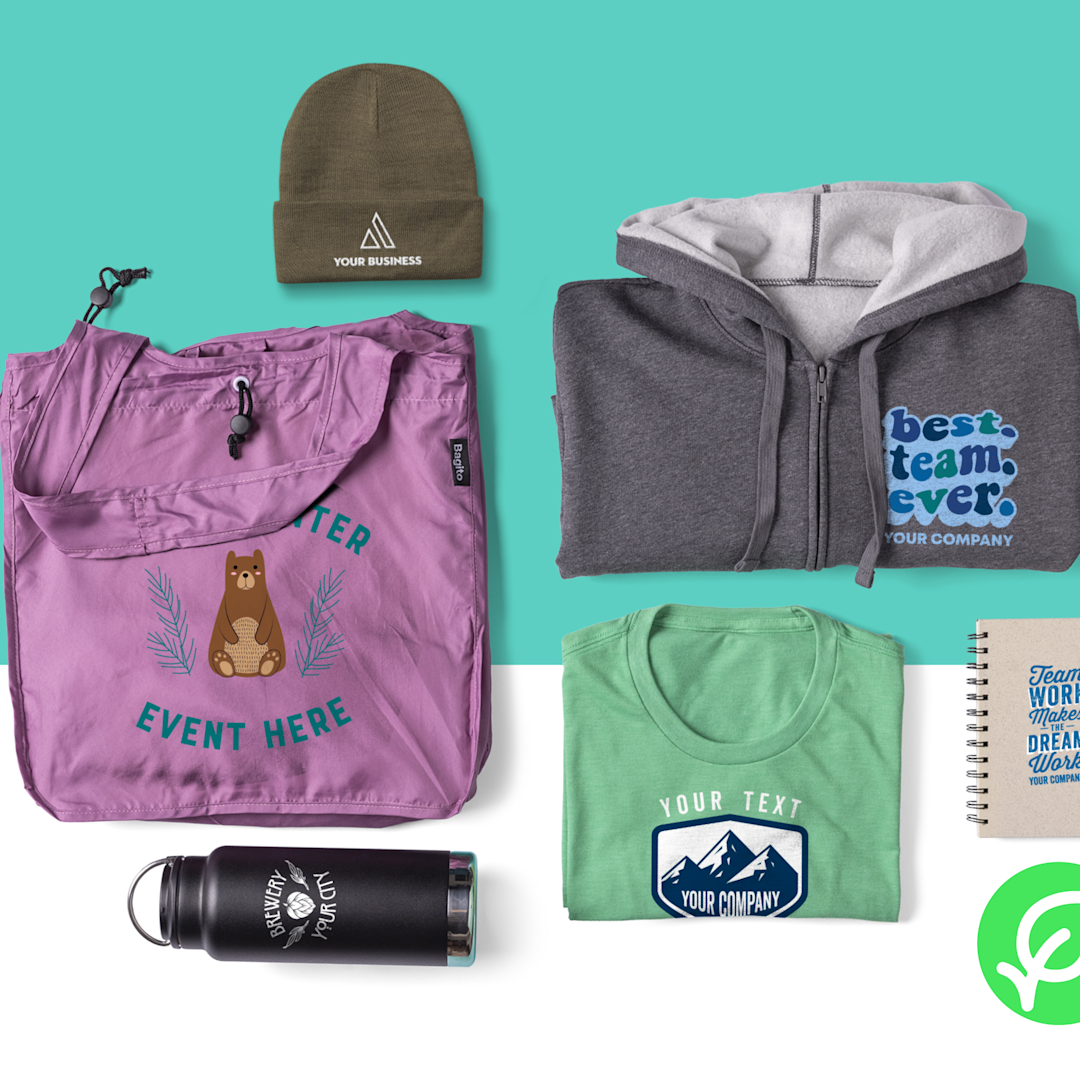
The most common objection to sustainable swag is the price tag. A recycled-content tee costs more than a standard one. A B Corp-certified water bottle runs more than a plastic giveaway bottle. That’s real, and it’s worth talking about honestly.
What’s also real: 47.6% of swag organizers say seeing their items end up in the donation pile or trash is their top motivation to order better next time, according to our 2026 Swag Trends Survey. The cheap version has a cost too — it just shows up later, and in someone else’s garbage.
This guide gives you the full picture: what sustainable promotional products actually cost at different budget levels, what the materials labels mean and which ones you can trust, and how to verify eco claims so you’re buying something real. Whether you’re outfitting a volunteer team, planning a company gifting program, or sourcing for a conference, the framework is the same.
In This Article
- What Sustainable Swag Actually Costs
- Materials Guide: What the Labels Mean
- How to Avoid Greenwashing
- Verified Eco and B Corp Brands on Custom Ink
- Frequently Asked Questions
Key Takeaways
- The real cost comparison is cost-per-impression, not cost-per-unit. Eco swag costs more upfront but is kept longer and generates more impressions, making the per-impression cost competitive with conventional products and dramatically lower than digital advertising.
- Material claims require third-party certification to mean anything. Recycled polyester verified by GRS saves ~70% greenhouse gas emissions vs. virgin; “organic cotton” without GOTS certification is unverifiable; “bamboo fabric” is almost always rayon, a distinction the FTC has enforced with $9.3M+ in penalties.
What Sustainable Swag Actually Costs
Our pricing adjusts based on product style, order quantity, and design complexity. The most accurate quote comes from our Design Lab or by calling our team. But the relative tier structure below gives a realistic planning framework for any budget conversation. Quantity bulk discounts apply across our sustainable catalog the same way they do on standard items.
| Tier | Example Product | vs. Conventional Equivalent | Primary Eco Credential | ASI Avg. Keep Rate |
|---|---|---|---|---|
| Budget Eco | Hanes EcoSmart 50/50 T-Shirt (169800) | Comparable to standard 50/50 tees | EcoSmart® recycled polyester from plastic bottles | 14 months |
| Mid-Range Eco | Recycled Cotton Convention Tote (575200) | Modest premium over basic cotton tote | Recycled cotton/poly, 7 oz. | 11 months |
| Premium Eco | Allmade Tri-Blend T-Shirt (810300) | 2–3× standard cotton tee | REPREVE® + organic cotton + TENCEL™ Modal; 6 recycled bottles/shirt | 14+ months |
| Premium Eco | Klean Kanteen 20 oz. Eco TKWide (1814700) | Significant premium over plastic bottle | 90% post-consumer recycled steel; Certified B Corp | 12 months |
The premium compounds into real value at program scale. According to the ASI 2026 Ad Impressions Study, outerwear and fleece, the highest-cost sustainable category, generates an average of 7,856 impressions and is kept for 16 months. At a $30 cost, that’s under half a cent per impression.
By contrast, PwC’s 2024 Voice of the Consumer Survey (20,000+ respondents, 31 countries) found consumers are willing to pay an average of 9.7% more for sustainably produced goods. The premium your employees and customers notice is in the positive direction. They associate higher-quality sustainable items with higher-quality brands.
The internal case is just as clear. Our 2026 Swag Trends Survey found that 47.6% of swag organizers say seeing items end up in the donation pile or trash is their top motivation to find better quality next time. That’s the hidden cost of cheap swag: replacement cycles, wasted budget, and a brand impression attached to something in a landfill.
Materials Guide: What the Labels Mean
The promotional products industry has no universal definition for “eco-friendly,” “green,” or “sustainable.” The terms are marketing language unless backed by third-party certification. The table below maps the most common material claims to their real environmental impact, the certification that verifies each claim, and the key limitation buyers need to know.
| Material | Real Environmental Impact | Certification to Require | Key Limitation / Greenwashing Risk |
|---|---|---|---|
| Recycled Polyester (rPET) | ~70% lower greenhouse gas emissions vs. virgin polyester (Textile Exchange LCA); ~90% less water. Diverts plastic bottles from landfill. | GRS (Global Recycled Standard): verifies recycled content percentage and full supply chain | Not all recycled polyester is GRS-certified. Ask for pre-consumer vs. post-consumer sourcing. Post-consumer (from used bottles) has greater impact. Microplastic shedding is an ongoing concern. |
| Organic Cotton | 91% lower water consumption vs. conventional cotton (Textile Exchange Life Cycle Assessment, via GOTS). Eliminates 100% of synthetic pesticides and herbicides by definition. | GOTS (Global Organic Textile Standard): min. 70% certified organic fiber for “made with organic” label; 95% for “organic” grade | OEKO-TEX Standard 100 certifies absence of harmful substances but does NOT verify organic farming or environmental production practices. Frequently confused with an eco certification. It is not one. |
| RPET (Recycled PET Plastic) | 79% lower CO₂ emissions vs. virgin PET plastic (denkstatt lifecycle analysis). Each kg of rPET diverts ~60 plastic bottles. Used in water bottles, tote bags, backpacks. | GRS or RCS (Recycled Claim Standard): chain-of-custody verification required for each supplier in the chain | rPET can’t be recycled infinitely; material quality degrades. Check whether the product is designed for recyclability at end of life, beyond being made from recycled content. |
| “Bamboo” Fabric | Bamboo grows fast and requires no pesticides as a plant. However: almost all “bamboo fabric” is rayon (viscose), produced by dissolving bamboo cellulose in chemical solvents including carbon disulfide. The resulting fiber retains no eco properties of the plant. | No standard certification for “bamboo fabric.” Only mechanically processed bamboo (rare, expensive) qualifies as genuinely eco. Look for Oeko-Tex on rayon if safety is the concern. | Major FTC enforcement risk. The FTC has issued $9.3M+ in penalties to Kohl’s, Walmart, Amazon, Nordstrom, and others for labeling rayon as “bamboo.” Bamboo hard goods (desk items, chargers) with FSC-certified wood are a different story. Bamboo the plant is legitimate in non-textile applications. |
| Recycled Cotton | Reduces textile waste by recovering fiber from manufacturing offcuts or post-consumer garments. Lower energy and water footprint than virgin cotton production. | GRS or RCS for recycled content verification. OEKO-TEX for substance safety. | Recycled cotton fibers are shorter, reducing durability and affecting print quality. Best in blends (cotton/poly) rather than 100% recycled cotton. Quality varies significantly by source. |
One certification missing from most promotional products discussions: OEKO-TEX Standard 100 is widely cited as an eco credential, but it tests only for the absence of harmful substances (PFAS, heavy metals, azo dyes) in the finished product. A shirt can be OEKO-TEX certified and made from 100% virgin petroleum-derived polyester. It confirms the product won’t harm the wearer. It does not verify sustainable production methods.
How to Avoid Greenwashing
The FTC’s Green Guides (16 CFR Part 260) make broad, unqualified environmental marketing claims like “eco-friendly,” “green,” “natural,” “sustainable” are legally problematic when unsubstantiated. The FTC considers such claims deceptive because they imply specific, far-reaching environmental benefits that are nearly impossible to prove.
Enforcement has been consistent and expensive: Kohl’s paid $2.5 million and Walmart paid $3 million in 2022 for marketing rayon textiles as “bamboo,” in actions the FTC described as “the largest-ever civil penalties for environmental marketing violations.”
As PPAI’s Director of Sustainability, Elizabeth Wimbush, has noted: sustainability claims in promotional products require verified data, not marketing language. And per research shared at PPAI Expo 2025, 42% of consumers say they can tell when a company is greenwashing, and 55% say they’d stop doing business with a brand they caught doing it.
Five questions to ask any supplier before purchasing promotional items made from recycled materials or other eco claims:
| Question | What to Listen For | Red Flag Answer |
|---|---|---|
| What specific third-party certification does this product hold? | A named cert with a verifiable certificate number: GRS, GOTS, FSC, B Corp, Fair Trade | “It meets our internal eco standards” or a self-created eco logo |
| What percentage of the product is recycled or organic, and is that pre- or post-consumer? | A specific number (e.g., “50% post-consumer recycled PET verified by GRS”) and documentation | “It contains some recycled materials” with no percentage |
| Can I verify this certification in the certifying body’s public database? | Yes. GRS/GOTS at textileexchange.org, FSC at fsc.org, B Corp at bcorporation.net, each searchable in seconds | Hesitation, or “our supplier handles that” |
| If labeled “recyclable” or “compostable,” where can it actually be recycled or composted? | Specific infrastructure requirements and whether local programs handle it | “It’s recyclable!” without specifying that curbside programs in most markets don’t accept it |
| If labeled “bamboo,” is this a textile or a hard good, and if textile, how was the fiber processed? | Mechanical processing (rare) or an acknowledgment that it’s rayon/viscose made from bamboo | “100% bamboo” on a soft textile without specifying the fiber processing method |
The 30-second verification test: search the supplier’s certificate number in the relevant database. GRS and GOTS certificates are searchable at textileexchange.org. FSC certificates are at fsc.org. B Corp status is at bcorporation.net. Any legitimate certification clears this in under a minute. If a supplier can’t provide a certificate number, the claim is unverified.
Verified Eco and B Corp Brands on Custom Ink
B Corp certification, awarded by B Lab after a rigorous independent audit across governance, workers, community, and environment, is the highest verification that an entire company operates sustainably as a whole, verifying the entire company rather than individual products. Minimum score to qualify is 80 of 200 points; brands significantly above that threshold demonstrate sustained, audited commitment. Four B Corp-certified brands are available through Custom Ink:
| Brand | B Corp Score | B Corp Since | Available Products | Key Eco Credential |
|---|---|---|---|---|
| Patagonia | 166.0 | 2012 | Fleece jackets, vests, puffers, caps, bags. Embroidery-only, quote-based ordering via our Patagonia page | 1% For The Planet; Ironclad Guarantee; recycled fabrics throughout; company profits directed to environmental causes |
| Klean Kanteen | 110.9 | 2012 | 20 oz. Eco TKWide, 27 oz. Eco Classic, 32 oz. Eco TKWide, 16 oz. Eco Tumbler, and more | 90% post-consumer recycled stainless steel; Climate Lock™ insulation; Klean Coat™ finish |
| ChicoBag | 131.5 | 2013 | Vita Large Recycled Poly Tote, Original Grocery Tote | 100% post-consumer recycled plastic bottles; designed specifically to replace single-use bags |
| MiiR | 95.5 | 2014 | 23 oz. Insulated Water Bottle, 12 oz. Tumbler, 12 oz. Camp Mug, 15L Computer Backpack, and more | Every product sold funds community empowerment and environmental projects ($3.5M+ donated); 1% For The Planet member |
Patagonia operates on a different model than most brands on our platform. Orders go through a consultative process, require brand approval, and use embroidery rather than screen printing. For high-visibility executive gifts or CSR milestone recognition, that gatekeeping is part of the value: every Patagonia order carries the company’s full sustainability commitment behind it.
For volume corporate swag programs, Klean Kanteen, MiiR, and ChicoBag deliver comparable B Corp credentials at more accessible price points and through our standard ordering flow.
The GoGreenTeam at Washington Hospital Center’s patient financial services department experienced the value of that kind of institutional backing firsthand. The team, founded by Kimberly Gilbert to inspire colleagues to reduce, reuse, and recycle in their everyday lives, held their Earth Day event at the hospital with full department support. Custom Ink helped them pull it off on time and on budget.

“Our patient financial services department, with the support of our AVP, Sabrina Sims, started an environmentally friendly team. Founded by Kimberly Gilbert, we set out to inspire our co-workers to reduce, reuse and recycle in their everyday lives. The event was held on Earth Day, 2009, here at Washington Hospital Center in Washington, D.C. CustomInk was extremely instrumental in our pulling this event off effectively and helped to show we are truly a team effort, committed to SAVING OUR PLANET!”
Design Inspiration for Sustainability Initiatives
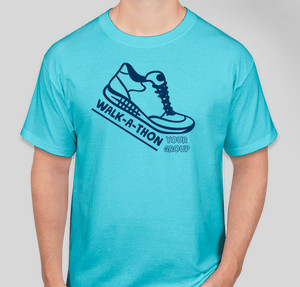
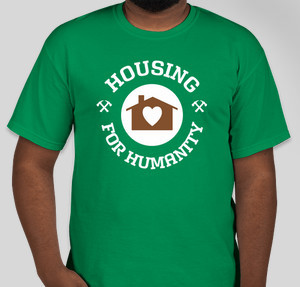
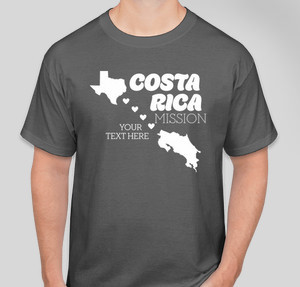
Whether you’re outfitting a green team, a CSR volunteer day, or a cause walk, our Design Lab has templates ready to customize with your logo, colors, and messaging:
Frequently Asked Questions
Q: How much more do promotional items made from recycled materials cost vs. standard products?
The premium depends on the product and the certification. Entry-level eco items like the Hanes EcoSmart 50/50 T-Shirt (recycled plastic bottle content) are priced comparably to standard 50/50 blended tees. Mid-range certified options like our recycled cotton totes carry a modest premium. Premium eco items like the Allmade Tri-Blend (REPREVE® recycled polyester, organic cotton, TENCEL™ Modal, ClimeCo certified) run 2–3× a standard cotton tee. Because our pricing is quantity-based, bulk orders narrow the premium significantly. The most accurate quote for any product at your specific quantity is available through our Design Lab or by calling our team at 800-293-4232.
Q: What is the difference between recycled polyester and organic cotton, and which should I choose for my program?
Recycled polyester (rPET) is made by collecting post-consumer plastic bottles, shredding them, and reprocessing the material into new fiber. It saves approximately 70% of the greenhouse gas emissions associated with virgin polyester production and diverts plastic waste from landfills. Look for GRS (Global Recycled Standard) certification to verify the content and supply chain. Organic cotton is grown without synthetic pesticides or herbicides under a certified farming standard. GOTS-certified organic cotton uses 91% less water than conventional cotton and eliminates synthetic chemical inputs entirely. Neither material is universally better. rPET is usually more cost-accessible and better for performance applications; organic cotton is softer, more breathable, and better for lifestyle or premium apparel. Both are measurably superior to their conventional counterparts when third-party certified. The Allmade Tri-Blend uses both simultaneously: 50% REPREVE® recycled polyester plus 25% organic cotton.
Q: Is “bamboo fabric” actually eco-friendly?
Almost never, when it comes to soft textiles. Bamboo fabric is almost always rayon (viscose) made by dissolving bamboo plant material in chemical solvents including carbon disulfide, a process that strips out any eco properties of the bamboo plant. The FTC has pursued this issue aggressively: Kohl’s and Walmart paid $5.5 million combined in 2022 in what the FTC called the largest-ever civil penalties for environmental marketing violations, specifically for labeling rayon as “bamboo.” The exception: bamboo hard goods (desk accessories, wireless chargers, notebooks) where bamboo is used as a structural material rather than a textile fiber. FSC-certified bamboo in hard goods is a legitimate and renewable alternative to plastic or virgin wood.
Q: Does Custom Ink carry Patagonia products?
Yes, through a consultative ordering process. Patagonia requires brand approval and uses embroidery as the primary decoration method, which is in keeping with the brand’s emphasis on durability and quality over volume. It’s a better fit for executive gifts, CSR milestone recognition, or premium employee appreciation programs than high-volume trade show giveaways. View our Patagonia page to start a conversation. For programs that need the B Corp credibility at higher volumes and through our standard ordering flow, Klean Kanteen, MiiR, and ChicoBag are strong alternatives, all with verified B Corp scores above 95.
Q: How do I get help choosing sustainable swag for my program?
Our design experts are available seven days a week to help you narrow down product options, match materials to your certification requirements, and build a swag kit that holds up to scrutiny. For programs with specific ESG reporting needs or volume requirements, our pro services team handles larger, more complex orders. Free standard shipping applies to all orders, with rush options available for tighter timelines. You can also browse our full sustainable swag catalog to filter by material type and product category.
Sustainable promotional products cost more per unit. They also last longer, generate more impressions, earn more goodwill, and carry the kind of verified environmental credentials that protect your organization from greenwashing risk. The math works in your favor. The only variable is choosing products with the certifications to back up the claims. Browse our sustainable swag catalog, or reach out to our team to build a program that matches your budget and your values.

The Custom Ink Staff is a team of design enthusiasts and promo product experts dedicated to bringing your ideas to life. From screen printing secrets to the latest trends in custom gear, we draw on decades of collective experience to help you create something unforgettable.